


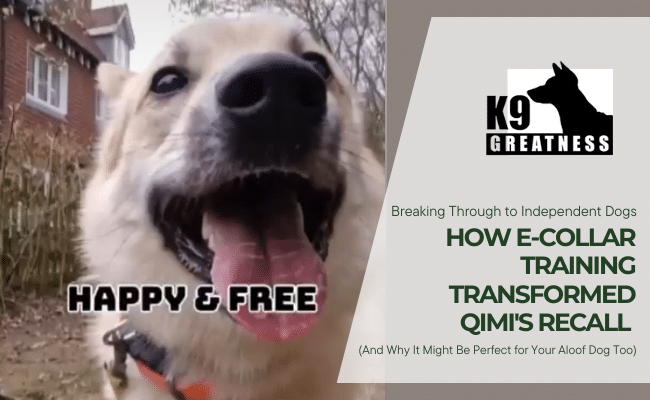
Some dogs live to please their humans. They hang on your every word, watch your face for cues, and seem genuinely distressed when they’ve disappointed you. Then there are dogs like Qimi—sharp, independent thinkers who operate on their own terms and seem to view your requests as mere suggestions rather than commands.
If you’re living with an aloof, independent dog who treats recall training like an optional activity, you’ll understand the unique challenges that come with this personality type. Traditional training methods that work brilliantly with eager-to-please dogs often fall flat with these self-directed characters.
The Independent Dog Dilemma
Qimi is what many would call a “difficult” dog to train—not because he lacks intelligence, but because he possesses too much of it. He’s a sharp, independent thinker who evaluates every situation on his own terms. When you call him, you can practically see him weighing up his options: “What’s in it for me? Is what I’m currently doing more interesting than what my human wants? How many times will they repeat themselves before they give up?”
This type of dog presents a unique challenge for traditional training methods. Positive reinforcement techniques that work beautifully with handler-focused breeds often struggle to compete with the environment when dealing with independent thinkers. How do you make yourself more interesting than that fascinating scent trail, that distant dog, or that intriguing rustle in the bushes?
For aloof dogs who aren’t naturally handler-focused, the gap between human intention and canine understanding can feel insurmountable. You find yourself repeating commands, raising your voice, feeling frustrated as your dog continues to operate in their own world, blissfully unaware of (or choosing to ignore) your increasingly desperate attempts to communicate.
The Communication Breakthrough
Teaching Qimi the foundations of e-collar recall has been a joy to witness. The transformation didn’t happen overnight, but when it did happen, it was profound. The e-collar gave us a clear, consistent way to communicate—even at distance—that transcended the limitations of voice commands and food rewards.
For dogs like Qimi, who process information differently than their people-pleasing counterparts, the e-collar provides something traditional methods often can’t: absolute clarity. There’s no ambiguity, no room for interpretation, no wondering whether that command was really meant for them or if they can get away with ignoring it just this once.
This isn’t about dominance or showing the dog “who’s boss.” It’s about creating a communication system that works for both species involved. The e-collar bridges that gap without frustration or nagging, providing a clear channel of communication that respects the dog’s intelligence whilst establishing non-negotiable boundaries.
Beyond Punishment: Understanding Pressure and Release
One of the biggest misconceptions about e-collar training is that it’s about punishment. In reality, effective e-collar work is about pressure and release, timing, and clarity. It’s a communication system based on the same principles that horses respond to when being ridden—clear signals that allow for immediate feedback and release when the desired response is given.
With Qimi, the process was about teaching him to understand the pattern: pressure applied, correct response given, pressure immediately released. This system appeals to intelligent, independent dogs because it’s logical, consistent, and fair. There’s no guesswork, no emotional manipulation, no begging or pleading—just clear cause and effect.
The beauty of this approach is that it works with the dog’s natural learning patterns rather than against them. Independent dogs often struggle with traditional training because they’re looking for logical systems they can understand and predict. The e-collar provides exactly that—a consistent, reliable communication method that makes sense to analytical minds.
The Transformation Process
Once Qimi understood the pattern, his responsiveness skyrocketed. This wasn’t about breaking his spirit or making him submissive—it was about giving him a clear framework within which he could operate. He didn’t become less independent; he became more responsive within his independence.
The change in his behaviour was remarkable. He began checking in more during walks, not out of anxiety or insecurity, but because he understood that maintaining connection with his handler was part of the system. He listened faster because the communication was clear and consistent. Most importantly, he began to enjoy his freedom safely—the very thing that makes independent dogs so special was preserved while adding the safety net of reliable recall.
This is the goal of any good training program: not to change the dog’s personality, but to give them the tools to express that personality safely and appropriately. Qimi is still the same sharp, independent thinker he always was—he’s just learned to operate within a clearer communication framework.
Why Traditional Methods Often Fall Short
Many owners of independent dogs have tried everything: higher-value treats, longer training sessions, different training methods, more patience, more consistency. Yet the results remain frustratingly inconsistent. The dog might recall perfectly in the garden but completely ignore you at the park. They might respond beautifully during training sessions but act as if they’ve never heard their name during real-world scenarios.
This inconsistency isn’t due to stubbornness or lack of intelligence—it’s often a communication problem. Traditional methods rely heavily on the dog’s desire to please their human, but independent dogs aren’t wired this way. They need logical, consistent systems that make sense to their analytical minds.
The e-collar provides this logical consistency. It removes the emotional component from training and replaces it with clear, predictable communication. For dogs who think rather than just react, this systematic approach is often exactly what they need to succeed.
The Freedom Paradox
One of the most beautiful aspects of successful e-collar training is that it actually increases the dog’s freedom. Before training, Qimi’s independent nature meant he had to be restricted—kept on lead in many situations where other dogs might be trusted off-lead. His freedom was limited by his unreliability.
Now, with reliable recall established, he enjoys much more freedom than ever before. He can explore, investigate, and express his natural behaviours while his owner has confidence that he’ll respond when called. This is the paradox of good training: temporary restrictions and clear boundaries ultimately lead to greater freedom and trust.
Is Your Dog a Good Candidate?
If you’re reading this and recognising your own dog in Qimi’s description, e-collar training might be the breakthrough you’ve been looking for. This method tends to work particularly well with:
- Intelligent, independent dogs who seem to evaluate every command
- Dogs who respond inconsistently to traditional training methods
- Breeds known for being aloof or less handler-focused
- Dogs who recall well in low-distraction environments but struggle in real-world situations
- Animals who seem to understand what you want but choose when to comply
The key is working with a trainer who understands that e-collar training is about communication, not punishment. The goal is to create a dog who chooses to respond because the communication is clear and the system makes sense, not because they’re afraid of consequences.
The Relationship Revolution
Perhaps the most remarkable aspect of Qimi’s transformation is how it strengthened rather than damaged his relationship with his handler. By removing the frustration and nagging that often characterises interactions with independent dogs, the e-collar actually improved their connection.
When communication is clear and consistent, both dog and human can relax into the relationship. The human stops feeling like they’re constantly battling for attention and compliance. The dog stops feeling pressured by unclear or inconsistent expectations. What emerges is a partnership based on mutual respect and understanding.
Your Dog’s Potential
If you’re struggling with an independent, aloof dog who treats recall as optional, know that transformation is possible. Your dog’s intelligence and independence aren’t obstacles to overcome—they’re assets to work with. The right training approach can turn those challenging traits into strengths.
Every sharp, independent dog has the potential to become reliably responsive while maintaining their unique personality. The key is finding a communication system that works with their natural tendencies rather than against them.
Ready to unlock your independent dog’s potential? If you’re tired of inconsistent recalls and want to give your intelligent, aloof dog the clear communication they’re craving, book a consultation to explore whether e-collar training is right for your partnership. Transform frustration into freedom, and discover what’s possible when you speak your dog’s language.
K9 Greatness – Where training is transparent, effective, and enjoyable.
Let’s start your dog’s transformation today! 🐾