


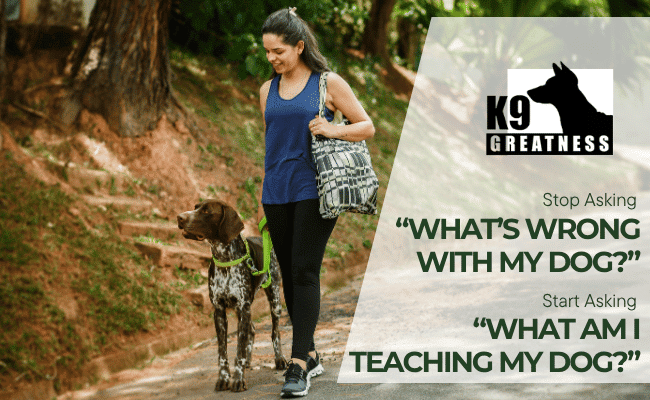
Most unwanted behaviour doesn’t appear out of nowhere.
And while breed, genetics and individual temperament can influence how a dog behaves, they aren’t the whole story. The way a dog is handled, the environment they live in, the boundaries they experience and the behaviours that are repeatedly reinforced all play an important part in what they learn.
In fact, many owners are unknowingly teaching their dogs behaviours they later spend months trying to undo.
So perhaps it’s time to ask a different question.
Instead of:
“What’s wrong with my dog?”
Ask:
“What am I teaching my dog every single day?”
That’s where lasting change begins.
Your Dog Is Always Learning
Training doesn’t only happen when you pick up a lead or deliberately practise a command.
Your dog is learning from you all the time.
They learn from what you allow.
They learn from what you ignore.
They learn from what gets rewarded.
They learn from whether boundaries are consistent or constantly changing.
If your dog pulls towards something and eventually gets there, they may learn that pulling works.
If they bark for attention and eventually receive it, they may learn that barking gets results.
If they ignore a recall and nothing happens, they may learn that the recall isn’t particularly important.
These lessons can happen without you consciously deciding to teach them.
Confusion Creates Inconsistency
Imagine being told that something isn’t allowed one day, only to be encouraged to do it the next.
From your perspective, the rule might be obvious.
From your dog’s perspective, it isn’t.
Consistency helps dogs understand what is expected of them. Dogs Trust similarly highlights consistency in training and routine as important for helping dogs understand expectations and reducing confusion.
This is particularly important when an entire household is involved.
If one person allows the dog on the sofa, another tells them to get down, and someone else ignores it completely, the dog isn’t being given a clear message.
The same applies to walking, recall, jumping, barking and boundaries.
Behaviour Is Often a Reflection of What Works
Dogs repeat behaviours that achieve something for them.
That doesn’t mean they’re manipulating you or deliberately trying to cause problems.
It means they’ve learnt through experience.
If a particular behaviour produces a result they want, there is a reason for them to try it again.
This is why simply trying to suppress unwanted behaviour without addressing what the dog has learnt can lead to the same problem returning in another form.
You might stop one behaviour, but if the underlying relationship and expectations haven’t changed, another behaviour can take its place.
Stop Chasing Quick Fixes
The internet is full of quick fixes.
A new technique.
A new gadget.
A new command.
A new reward.
A new approach promising to solve your dog’s behaviour in a matter of days.
The problem is that lasting behaviour change rarely comes from one isolated technique.
It comes from changing the way the dog experiences everyday life.
Dogs Trust’s research shows just how widespread behaviour challenges are, with 90% of surveyed owners reporting at least one in the previous year.
That means you’re certainly not alone if you’re struggling.
But the answer isn’t necessarily finding another trick to add to your toolbox.
Sometimes, the answer is to step back and look at the bigger picture.
Train the Relationship, Not Just the Behaviour
This is where the relationship between dog and owner becomes so important.
Your dog needs to understand you.
You need to understand your dog.
You need clear communication, predictable expectations and consistency in the way you interact.
Research and guidance from Dogs Trust emphasise that understanding canine behaviour and communicating appropriately can help prevent misunderstandings that contribute to unwanted behaviour.
The aim isn’t simply to make your dog perform a collection of commands.
It’s to build a relationship where your dog understands what you expect and can rely on you for clear guidance.
That’s a much bigger goal than teaching a sit or down.
The Human Has to Change Too
This is the part many owners don’t expect.
You can send your dog to the best trainer in the world, but eventually your dog comes home.
And that’s where the real training continues.
Your dog spends far more time with you than they ever will with a trainer.
So if the human behaviour stays exactly the same, why would we expect the dog’s behaviour to remain different?
Real progress often starts when the owner begins to recognise their own patterns.
Where am I inconsistent?
What behaviour am I accidentally rewarding?
Which boundaries am I failing to maintain?
Am I giving my dog clear information?
Am I reacting to behaviour, or am I proactively teaching what I actually want?
Those questions can be uncomfortable.
But they’re incredibly valuable.
When People Change, Dogs Change
Change the relationship and you can start changing the behaviour.
Not overnight.
Not through a magic command.
But through consistent communication, clear expectations and repetition.
Your dog doesn’t suddenly become a different animal.
Instead, they begin to understand the world differently because you’ve changed the way you communicate with them.
That’s when training starts to become something much more powerful than correcting individual problems.
You’re teaching your dog how to live successfully alongside you.
Why We Train the Human Behind the Dog
At K9 Greatness, we don’t just want to train your dog for you.
We want to teach you how to understand, communicate with and guide your dog long after the training session has finished.
That’s exactly why our Intensive Training Programme comes with training for life — for the human in the dog’s life.
Because the goal isn’t for you to depend on a trainer forever.
The goal is for you to understand your dog well enough to keep making progress together.
Your dog doesn’t need a perfect owner.
They need an owner who is willing to learn, become consistent and take responsibility for what they are teaching every day.
The Question That Changes Everything
So the next time your dog does something you don’t want them to do, pause before asking:
“What’s wrong with my dog?”
Ask yourself:
“What am I teaching my dog every single day?”
That question shifts the focus from blame to responsibility.
From quick fixes to lasting change.
And sometimes, changing the human is the first step towards changing the dog.
👉 Book a session and start transforming not just your dog’s life, but yours too.
At K9 Greatness, we don’t just train dogs—we teach owners how to build calm, confident relationships that last a lifetime.
So, what behaviour are you struggling with most? We’d love to help.